Introducing AterDB
PostgreSQL for everyday SQL workloads, RAG, and agent memory
More ways to query your data shouldn’t mean more databases to manage.
Applications need to query relational data, find relationships in a graph, and search over the text. Doing that through dedicated databases and storage systems means duplicated records, synchronization pipelines, and more systems to operate.
AterDB extends PostgreSQL itself to support multiple workloads on one proven shared data foundation, with no ETL between supported workloads. It is designed for enterprise scale, with the ability to build knowledge bases, search, and agent memory on top, within the powerful PostgreSQL ecosystem.
A mix of workloads calls for a modernized PostgreSQL engine. We’re modernizing query planning, compilation, and execution for faster queries and lower compute costs.
A foundation for connected applications and AI
Applications and agents need connected context to answer questions, store and discover relationships, assess the impact of changes, and resume earlier work.
AterDB delivers the shared foundation built for:
- Connected SaaS and enterprise applications. Use current customer, product, and entitlement records and their relationships in APIs and workflows.
- Knowledge bases, RAG or GraphRAG systems and hybrid search. Combine source material, business filters, and relationship evidence to retrieve context and trace answers to their sources.
- Agent state and memory. Preserve sessions, decisions, changing facts, and the context available when decisions were made.
- Developer tools and coding agents. Connect symbols, dependencies, and code versions with sessions and artifacts to recover context for a particular revision.
- Application search and shared enterprise context. Reuse business and technical knowledge across search, applications, and agents.
That means fewer systems to operate, more efficient storage, and lower costs and higher performance for agentic applications.
PostgreSQL with less integration work
AterDB builds on PostgreSQL’s engine, SQL model, and ecosystem, so teams can keep using their PostgreSQL knowledge and tooling as new workloads arrive.
Supported workloads share storage, removing the need to move data between databases just to query it differently.
Starting with graph and faster JIT compilation
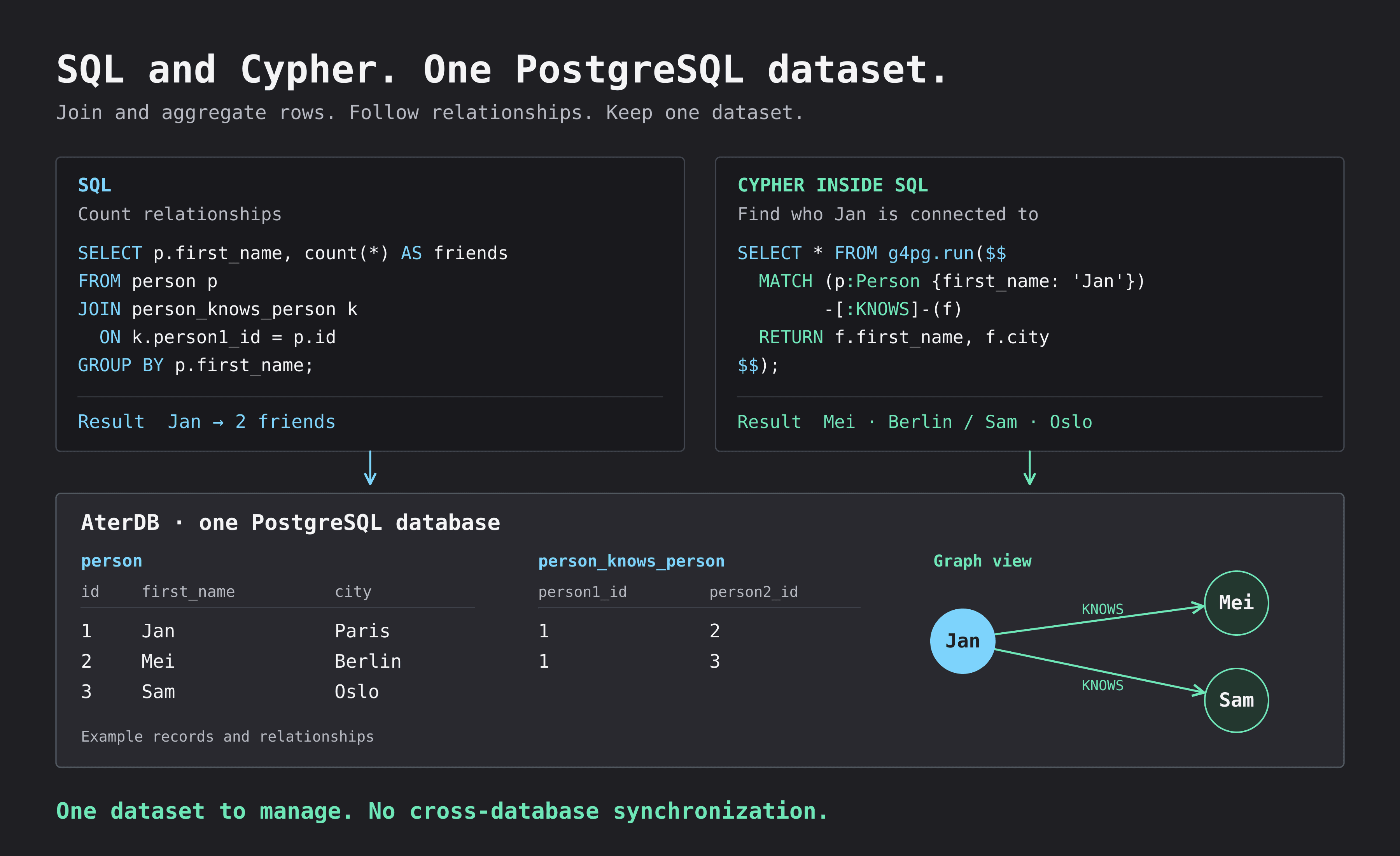
Graph is the first workload we’re opening up for exploration. Our live demo (LDBC Social Network Benchmark) lets you follow relationships alongside social network data.
The graph subsystem was built deeply integrated into the planning and execution core, which ensures high performance.
Challenging Cypher’s language features, such as variable length paths, multiple labels per node and dynamic properties run natively on top of the Postgres relational storage.
Graph queries can include full text search and vector clauses and utilize the corresponding indexes for faster execution. They can be executed from SQL sessions, fusing graph and relational workloads, as well as through Bolt (neo4j-compatible) protocol.
We’re also improving PostgreSQL query compilation and execution. The pg_jitter project introduces lightweight just-in-time (JIT) backends that generate native code faster. Our engine work also covers compiled query execution, PL/pgSQL compilation, and improved query planning to reduce overhead.
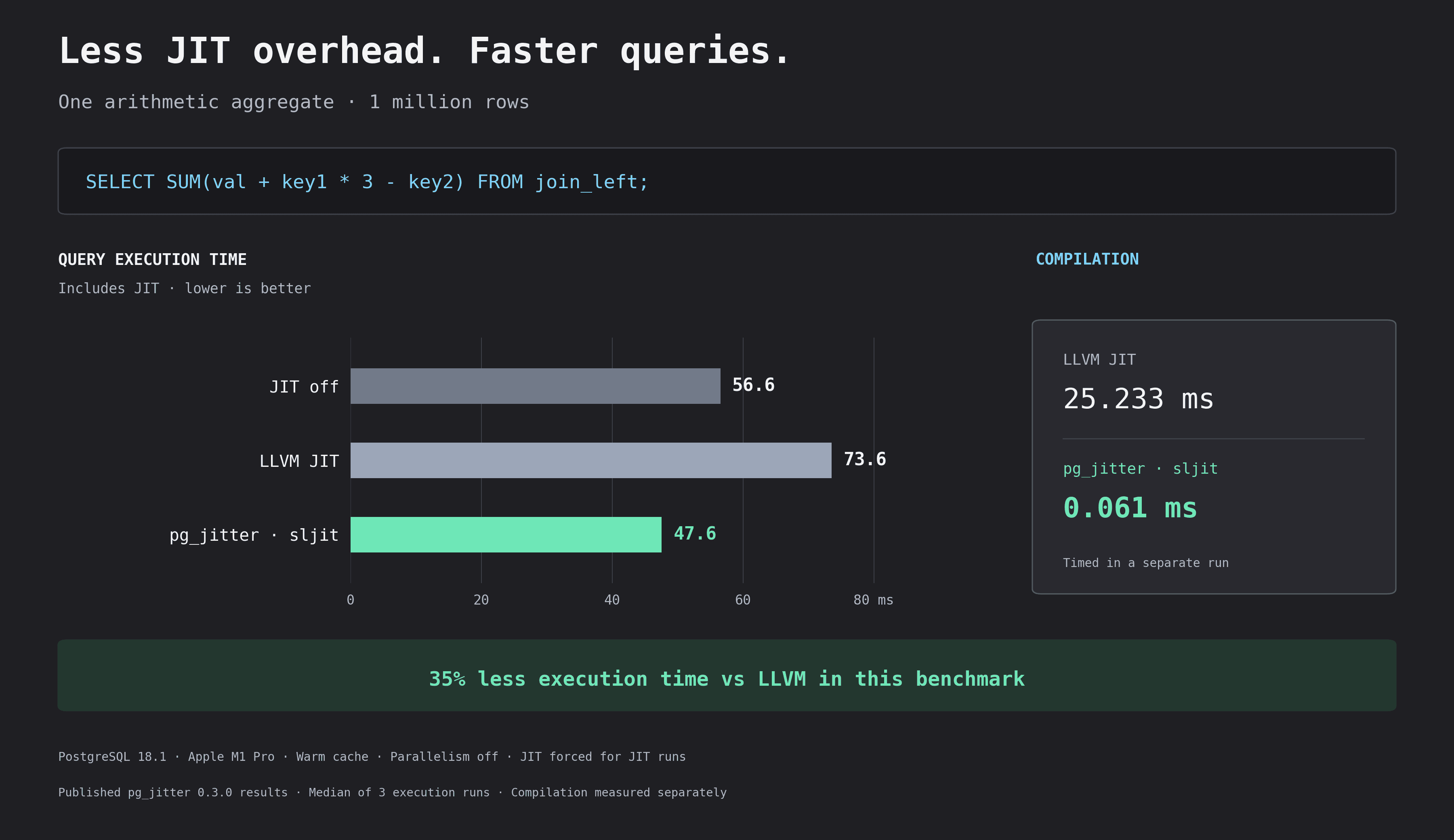
We’ll cover these changes in focused technical posts with reproducible examples, measuring both compilation and execution time.
Try the live demo
Today, AterDB is available as a live technical demo of graph and JIT capabilities.
We plan to introduce further capabilities over time, including key-value and document workloads, text and vector search, and analytics.
Try the live graph and JIT demo →